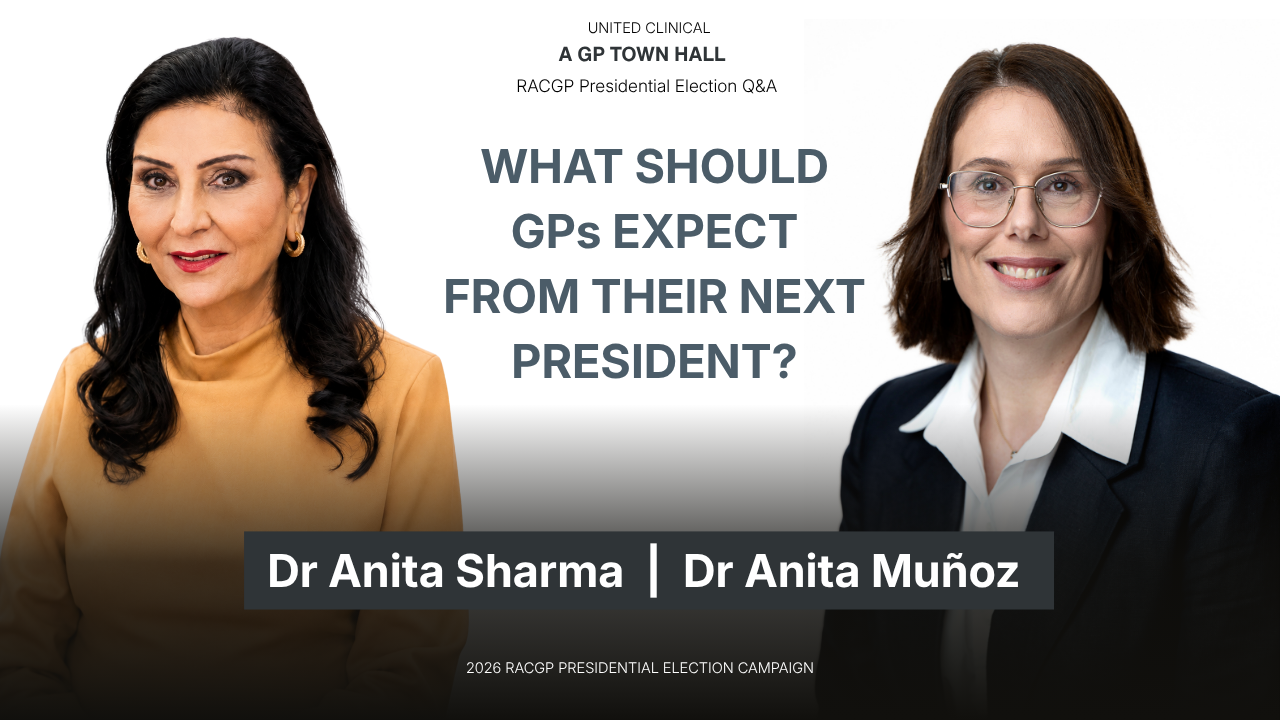
What should the next RACGP President understand about the pressures facing general practice, and what should members expect them to do about them?
That was the focus of A GP Town Hall: The Future of Primary Care, hosted by Dr Anita Sharma through United Clinical.
Importantly, the agenda wasn’t set by us. It was shaped by questions and priorities raised by GPs ahead of the Town Hall and what matters most to Australian GPs.
Across the discussion, the same issues came through clearly: the financial sustainability of general practice, administrative burden, workforce and training, equitable access and continuity of care, increasingly complex patient needs, and the need to strengthen the voice, identity and standing of our profession.
These are different challenges, but they are also deeply connected.
Funding Must Recognise the Value of General Practice
General practice is being asked to manage more complexity, coordinate more care and keep more patients well in the community.
Funding has not kept pace with that reality.
We need a serious conversation about what high-quality general practice is worth, including longer and more complex consultations, mental health care, multimorbidity and the work that happens outside the consultation room.
Affordability matters. So does the viability of the practices patients rely on.
We should not accept a system that treats those two things as mutually exclusive.
Give GPs Clinical Time Back
Administrative and regulatory burden was another clear concern.
Accountability and appropriate regulation are important. But complexity for its own sake takes time away from patients and contributes to frustration across the profession.
We need clearer systems, less unnecessary duplication and Medicare rules that GPs can reasonably understand and apply.
Reducing red tape isn’t about reducing standards. It’s about allowing GPs to spend more of their time doing the work they are trained to do.
Build a Profession Doctors Want to Join and Stay In
The GP workforce conversation needs to go beyond workforce numbers.
We need general practice to be a career that medical graduates actively choose, registrars are excited to enter and experienced GPs can sustain.
That means properly recognising the expert generalist. It means supporting supervisors and practices that train the next generation. It means valuing rural generalism and recognising the enormous contribution of international medical graduates to Australian healthcare.
And it means addressing the structural and financial pressures that make it harder for GPs to remain in the profession they love.
Improve Access Without Sacrificing Continuity
Access matters, particularly for rural and regional communities and patients experiencing disadvantage.
But access cannot be measured only by whether someone can obtain an appointment somewhere in the health system.
Continuity matters too.
Fragmented care creates its own costs and risks, particularly for patients with chronic illness, multimorbidity and complex needs.
As we build new models of care, we need to ask whether they strengthen the relationship between patients and their usual GP or further fragment it.
Multidisciplinary Care Should Remain GP-Led
Modern general practice increasingly involves multidisciplinary teams, and that presents enormous opportunities.
But multidisciplinary should not mean fragmented.
GPs are trained as expert generalists to work with uncertainty, undifferentiated illness and multimorbidity. That expertise matters when someone needs to hold the complete clinical picture and coordinate care across different professionals and services.
I support multidisciplinary care. I also believe strongly that its clinical governance should remain GP-led.
Respect and Recognition Must Translate Into Action
One of the strongest themes running through the Town Hall was respect and recognition for general practice.
For me, those words have to mean something.
Respect is reflected in how governments involve GPs in decisions about primary care.
Recognition is reflected in whether funding values the complexity and expertise of our work.
Trust is built when the profession has a genuine seat at the table and when its representatives are prepared to advocate clearly for members.
The College should be a constructive partner to government, but constructive advocacy does not mean politely agreeing with every decision.
We go to government to represent our members, bring evidence, offer solutions and argue for better outcomes.
That is the kind of advocacy I believe general practice needs.
Watch A GP Town Hall: The Future of Primary Care
The complete Town Hall and individual Q&A discussions are available to watch on YouTube.
The series explores:
Funding, Value & Practice Viability
Administrative & Regulatory Burden
Workforce, Training & Wellbeing
Access, Equity & Continuity
Complexity & System Integration
Voice, Identity & Trust
You can watch individual conversations on the issues that matter most to you, or watch the full Town Hall as one long-form discussion.
General practice is facing significant challenges, but I remain optimistic about our future.
We know many of the problems. We also know many of the solutions.
What matters now is having the leadership, advocacy and collective resolve to turn those solutions into outcomes.
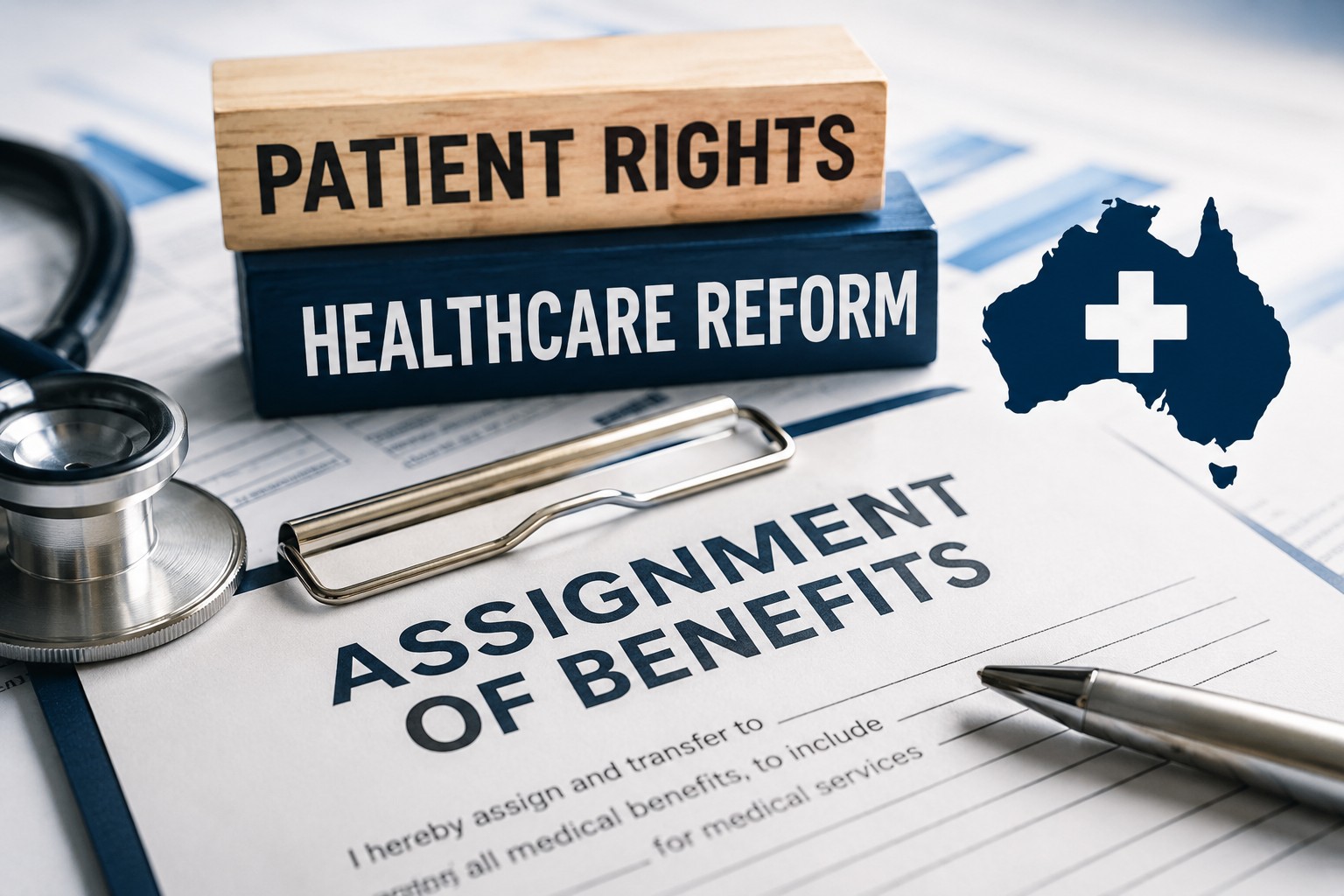
Yesterday the Federal Government announced important concessions to the proposed Assignment of Benefits (AOB) changes due to commence on 1 July.
Following extensive advocacy and collaboration between the RACGP and the Department of Health, a number of practical concerns raised by GPs have been recognised.
What Has Changed?
A 12-month grace period for implementation.
Continued use of verbal patient consent during the transition period.
Earlier implementation of enduring consent arrangements for eligible patients.
An educative rather than punitive approach to compliance.
These concessions will help reduce unintended consequences for patients and practices while allowing more time to implement the changes safely and effectively.
Importantly, the outcome demonstrates the value of constructive engagement between government, the profession and frontline clinicians. When policy development is informed by practical experience, better outcomes can be achieved for both patients and healthcare providers.
This is a positive step forward for general practice and a reminder that advocacy can make a difference.
“In this world, nothing can be said to be certain except death and taxes,” said Benjamin Franklin in a letter to his friend Jean-Baptiste Le Roy in 1789.
He wasn’t the first to say it. He pinched it from Defoe’s The Political History of the Devil (but let’s not go there.)
It’s since become a catch cry for modern life, its myriad uncertainties and the two great swords of Damocles – death and taxation.
As an optimist, I read into it that almost anything else can be fought for, saved, rescued or advocated for.
As a realist I read into it that everything else will need to be fought for, saved, rescued, advocated for.
Rural general practice sits firmly in that category. Many speak about its decline as though its death is inevitable. I don’t believe it is.
Why Rural GPs are Worried
In six years as Chair of Victoria at the RACGP, I have spoken to hundreds of GPs, practice managers and registrars; concern about the viability of rural practice is real and needs to be treated with respect.
Yet despite these challenges, I remain optimistic. Not because the problems are small—but because we already know many of the solutions.
Rural GPs face enormous workloads and relentless on-call demands, have fewer opportunities for leave, can be professionally isolated, and are at high risk of burnout.
The Funding Model is No Longer Sustainable
We have said it repeatedly and we’ll say it again now: Medicare rebates have been so poorly indexed over 25 years that many rural practices now lose money performing procedures. The cost of equipment, consumables and staff has risen well beyond the rebates paid to provide care.
Some GPs are effectively subsidising essential healthcare from their own businesses.
When I ask them why they do not charge a fee to at least cover the equipment costs, they just state flatly that patients now believe gap fees are outlawed and many become angry or simply refuse to pay.
When we turn the discourse to funding, the immediate riposte is the “greedy doctor” narrative that generates resentment from the public who now expect everything in general practice to be done for free. The fact is, expert generalists deserve to be remunerated for their lifetime of training, the extraordinary levels of responsibility they shoulder, the long hours of on call, their skills and knowledge and the risks they take in operating businesses in difficult circumstances. I have never read an article or political commentary that derides greedy pharmacy owners. That particular stiletto seems only to get lodged in the backs of doctors. And while self-sacrifice still seems to be synonymous with virtue in medicine, a GP can’t put their kids through school only banking virtue.
Red Tape is Taking Doctors Away from Patients
Rural GPs are also spending disproportionate amounts of time on administration, compliance and regulation requirements. Australia has a very proud history of high standards in medicine, but every hour spent on paperwork is an hour not seeing patients and not generating an income.
The system urgently needs to ask which administrative requirements improve quality—and which simply consume time without improving patient care.
Workforce Shortages are About More than Recruitment
Rural practices are also perennially challenged by attracting and retaining adequate workforce. We often read about doctors not being willing to go rural, but in fact the issues that hamper them are often structural and systemic. A rural town may not have adequate housing, childcare, schools, employment for non-medical spouses and opportunities for non-medical pursuits. It can also be very difficult for rural GPs to take leave and to access ongoing professional education. And even the most self-sacrificing GP will think twice before committing to a roster of endless on call because no adequate back up is available. What we need is to attract, train and retain rural GPs and to do that we need to retain the entire medical family.
The Old Model of Rural Medicine is No Longer Sustainable
And while we often hear nostalgic and misty-eyed praise of the rural GP of the past who worked 6 days a week, saw 60 patients a day, was on call for months at a time, and required a full-time stay-at-home spouse in order to survive, we have to be brave and recognise that that model of medicine is not sustainable, reasonable or safe. It’s an anachronism.
Meet Henry. He’s part of the team at my practice. Lately he’s been demonstrating exactly how many rural GPs are feeling…
Rural Practice Remains One of the Most Rewarding Careers in Medicine
Despite these challenges, most rural GPs love their work, love their communities and espouse the satisfaction and value of their profession.
The Broadest Scope of Practice is Medicine
For many doctors, the appeal of rural practice lies in the clinical autonomy, enormous variety and scope of practice and deep connection to their patients. Rural GPs deliver the full continuum of care—treating generations of families and whole communities, performing myriad procedures, often with admitting rights at local hospitals. They often have advanced skills in obstetrics, anaesthetics, general surgery, palliative care, emergency medicine, paediatrics. These people are the Swiss Army Knives of the medical world and can deploy their skills in a variety of settings.
When things go wrong, there are few doctors with broader skills than a rural GP.
If you find yourself in a survival situation the best thing you could ask for is an Australian rural GP. Any doctor whose emergency skills include liaising with the local vet to keep the supply of atropine flowing is no ordinary clinician.
Why Burnout Remains the Greatest Threat
But while rural GPs report high satisfaction and love of their work, they are also the most likely of all the medical professionals to experience burnout. It is the huge and relentless workload followed by administrative and systems barriers they cite as the leading problems.
The Solutions Already Exist
The encouraging news is that none of these problems are beyond our capacity to solve. We already know what works. The challenge is having the leadership and the courage to implement those solutions consistently.
Listen to those Working on the Frontline
Over the past six years, I’ve spent a great deal of time visiting rural practices and listening to GPs, practice teams, supervisors, registrars and the communities they serve. One lesson has become abundantly clear: the best rural health policy is not designed in isolation. It is built by bringing frontline experience into every advocacy conversation and turning it into practical, evidence-based reform. That is how lasting change is achieved.
We can’t make rural GPs immortal, and we can’t stop their requisite yearly homage to the Tax Man, but we absolutely can prevent their profession from decline.
Strengthen Rural Generalism
Rural generalism is now a recognised specialty of medicine which is bringing recognition, respect and a protected title to the profession. More trainees than ever are enrolling in RG pathways and taking up advanced skills. To consolidate on that trend, we need rural health services to create positions for RGs to use and retain their skills. Country hospitals need to welcome RGs with open arms so that the vision of the Collingrove Agreement can be realised: highly trained GPs working in local general practice and utilising advanced skills in local hospitals and community settings, thereby bridging the gap between the two. The Single Employer Model seeks to realise that opportunity but applies only to some trainees. Its intent must be replicated in permanent positions post fellowship. We must also remunerate a GP’s advanced skills in recognition of their value and the huge relief those skills bring to the health system at large fiscally, logistically and geographically.
Support the Supervisors Training the Next Generation
Rural training and workforce pipelines can only flourish, however, if there are adequate supervisors available to support incoming trainees. Alongside RACGP’s huge success in recruiting more registrars into rural practice is the repeated call to properly remunerate supervisors for the time, effort and commitment they make to teaching the GPs of the future.
You can’t do everything for the love of it, and we can’t keep rewarding people who do more by giving them less.
We also have a precious opportunity to make the trainees of today into the supervisors of tomorrow if we get that model right.
Protect Professional Autonomy
Significant positives in the world of rural health include the many grant opportunities, RG support, government focus on rural medicine, financial incentives loadings and local workforce solutions that GPs can consolidate on to meet the needs of their communities. But remember what brings GPs the greatest satisfaction and protection from burnout: autonomy and relief from unnecessary red tape. Rural GPs must be left with the autonomy to bill and to practice medicine independently. Handcuff them to funding restrictions, limit their ability to innovate and build bespoke multidisciplinary teams, or preclude them from using their skills and capacity independently and their communities will suffer and they may walk away.
Recognise the Contribution of International Medical Graduates
One group deserves far greater recognition in this conversation. More than 50% of GPs in Australia are international medical graduates. Many IMGs have committed their lives to the service of rural communities. In fact, Australia’s health system would have collapsed decades ago were it not for our IMG community working in general practice and every other specialty. Their story has been woefully overlooked in the story of our health system. Many of our own systems make entering our country and flourishing in medicine orders of magnitude more difficult than it needs to be for IMGs. We have also an urgent need to create attitudes of celebration and gratitude for their service to replace darker narratives that have long existed.
Rural Practice is Worth Saving
When I think about rural GPs I think resilient, intelligent, resourceful and deeply committed. I don’t think they are inexhaustible. They are human.
I know that the future should not be designed from Canberra alone, but our federal funders are key stakeholders in our vision for a robust, equitable and sustainable rural general practice. In the modern age of co-design, the very best thing we can do is ask our rural GPs and their patients what is needed to secure their collective futures and to act on that advice.
Rural practice doesn’t need sympathy. It needs sensible policy, genuine respect, and leaders willing to back the doctors who have been holding rural Australia together for generations.