What should the next RACGP President understand about the pressures facing general practice, and what should members expect them to do about them?
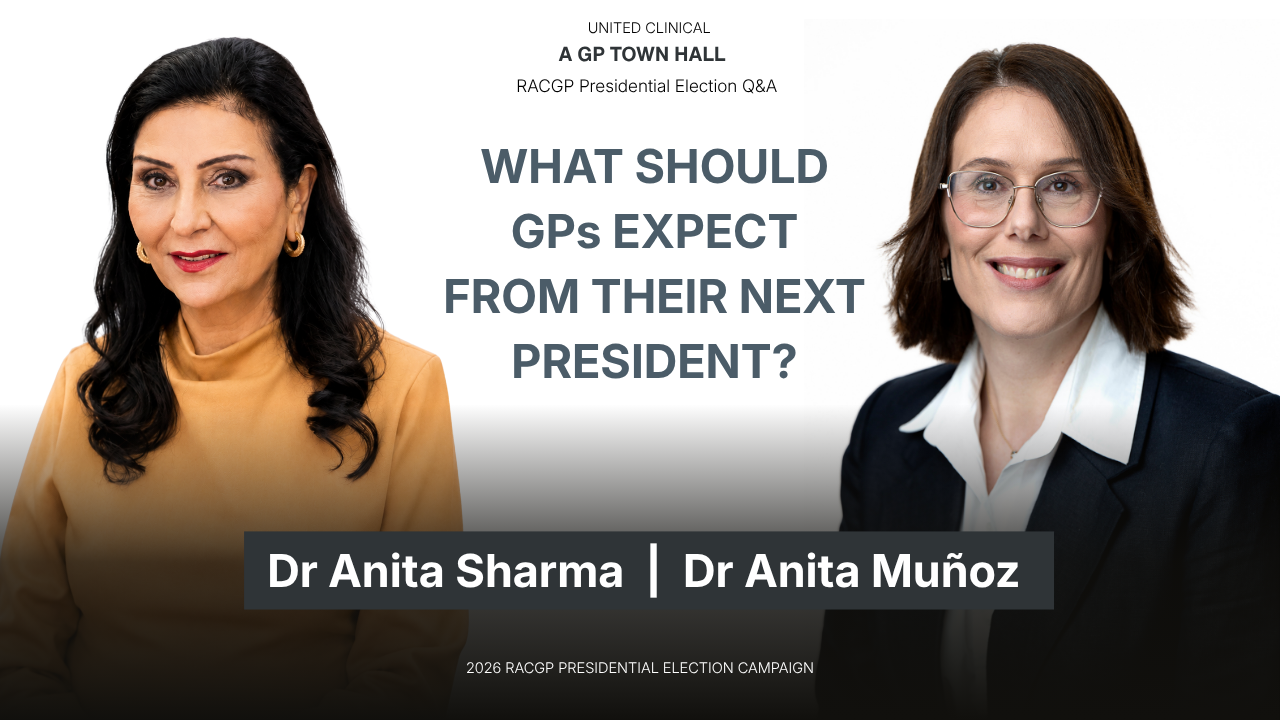
That was the focus of A GP Town Hall: The Future of Primary Care, hosted by Dr Anita Sharma through United Clinical.
Importantly, the agenda wasn’t set by us. It was shaped by questions and priorities raised by GPs ahead of the Town Hall and what matters most to Australian GPs.
Across the discussion, the same issues came through clearly: the financial sustainability of general practice, administrative burden, workforce and training, equitable access and continuity of care, increasingly complex patient needs, and the need to strengthen the voice, identity and standing of our profession.
These are different challenges, but they are also deeply connected.
Funding Must Recognise the Value of General Practice
General practice is being asked to manage more complexity, coordinate more care and keep more patients well in the community.
Funding has not kept pace with that reality.
We need a serious conversation about what high-quality general practice is worth, including longer and more complex consultations, mental health care, multimorbidity and the work that happens outside the consultation room.
Affordability matters. So does the viability of the practices patients rely on.
We should not accept a system that treats those two things as mutually exclusive.
Give GPs Clinical Time Back
Administrative and regulatory burden was another clear concern.
Accountability and appropriate regulation are important. But complexity for its own sake takes time away from patients and contributes to frustration across the profession.
We need clearer systems, less unnecessary duplication and Medicare rules that GPs can reasonably understand and apply.
Reducing red tape isn’t about reducing standards. It’s about allowing GPs to spend more of their time doing the work they are trained to do.
Build a Profession Doctors Want to Join and Stay In
The GP workforce conversation needs to go beyond workforce numbers.
We need general practice to be a career that medical graduates actively choose, registrars are excited to enter and experienced GPs can sustain.
That means properly recognising the expert generalist. It means supporting supervisors and practices that train the next generation. It means valuing rural generalism and recognising the enormous contribution of international medical graduates to Australian healthcare.
And it means addressing the structural and financial pressures that make it harder for GPs to remain in the profession they love.
Improve Access Without Sacrificing Continuity
Access matters, particularly for rural and regional communities and patients experiencing disadvantage.
But access cannot be measured only by whether someone can obtain an appointment somewhere in the health system.
Continuity matters too.
Fragmented care creates its own costs and risks, particularly for patients with chronic illness, multimorbidity and complex needs.
As we build new models of care, we need to ask whether they strengthen the relationship between patients and their usual GP or further fragment it.
Multidisciplinary Care Should Remain GP-Led
Modern general practice increasingly involves multidisciplinary teams, and that presents enormous opportunities.
But multidisciplinary should not mean fragmented.
GPs are trained as expert generalists to work with uncertainty, undifferentiated illness and multimorbidity. That expertise matters when someone needs to hold the complete clinical picture and coordinate care across different professionals and services.
I support multidisciplinary care. I also believe strongly that its clinical governance should remain GP-led.
Respect and Recognition Must Translate Into Action
One of the strongest themes running through the Town Hall was respect and recognition for general practice.
For me, those words have to mean something.
Respect is reflected in how governments involve GPs in decisions about primary care.
Recognition is reflected in whether funding values the complexity and expertise of our work.
Trust is built when the profession has a genuine seat at the table and when its representatives are prepared to advocate clearly for members.
The College should be a constructive partner to government, but constructive advocacy does not mean politely agreeing with every decision.
We go to government to represent our members, bring evidence, offer solutions and argue for better outcomes.
That is the kind of advocacy I believe general practice needs.
Watch A GP Town Hall: The Future of Primary Care
The complete Town Hall and individual Q&A discussions are available to watch on YouTube.
The series explores:
- Funding, Value & Practice Viability
- Administrative & Regulatory Burden
- Workforce, Training & Wellbeing
- Access, Equity & Continuity
- Complexity & System Integration
- Voice, Identity & Trust
You can watch individual conversations on the issues that matter most to you, or watch the full Town Hall as one long-form discussion.
General practice is facing significant challenges, but I remain optimistic about our future.
We know many of the problems. We also know many of the solutions.
What matters now is having the leadership, advocacy and collective resolve to turn those solutions into outcomes.